Posted by: Dr. Grover B. Proctor, Jr. | 11 November 2014

My Father, My Hero


Remembering my hero, my father, on this Veterans Day.

He was a member of the 2nd Battalion, 345th Regiment, of the 87th Infantry Division in World War II, and fought with them during the Ardennes (Battle of the Bulge) and Rhineland (Siegfried Line) Campaigns. Among the medals we was awarded were the Bronze Star (for “Heroic or Meritorious Achievement”) and the Purple Heart (for “Military Merit”). In addition, he and the entire 2nd Battalion were awarded the very rare Presidential Unit Citation by authorization of President Harry S Truman.

My Father, My Hero

Unit Citation

“In the Name of the President of the United States”
for the 2nd Battalion, 345th Infantry Regiment

The 2nd Battalion, 345th Infantry Regiment, 87th Infantry Division, distinguished itself by its extraordinary heroism, savage aggressiveness and indomitable spirit during its advance through the Siegfried Line and capture of Olzheim, Germany. From 5 through 9 February, 1945, the 2nd Battalion attacked violently and captured Olzheim in the face of extremely difficult terrain, fanatical enemy resistance, and devastating artillery fire. In this exemplary accomplishment, the battalion advanced 11,000 yards, smashing 6,000 yards through the Siegfried Line, neutralized many pillboxes and bunkers, and captured 366 enemy prisoners. The Brilliant tactical planning, rapid capture of assigned objectives and the conspicuous gallantry of each member of the 2nd Battalion, 345th Infantry Regiment, 87th Infantry Division, are in keeping with the highest traditions of the military service.

The Presidential Unit Citation is equivalent in medal hierarchy to the Distinguished Service Cross, the second highest military award that can be given to a member of the United States Army. In order to receive it, a unit must exhibit “extraordinary heroism in action against an armed enemy” by displaying “such gallantry, determination, and esprit de corps in accomplishing its mission under extremely difficult and hazardous conditions so as to set it apart from and above other units participating in the same campaign.”

SiegfriedLineDaddy was a member of F Company of the 2nd Battalion / 345th Regiment, and on the morning of February 6, 1945 (my mother’s, his wife’s 20th birthday!), they were the first to break through the Line. The Company Historian summarized it this way: “They reached their objective a little before daylight. The company commander placed his men in positions to take the first pillbox by surprise. They were successful and before [the enemy] knew what was happening, the first pillbox was in ‘F’ Company’s hands.” A later Regimental History expanded on F Company’s attack this way: “Adverse weather conditions and unfavorable terrain made rapid progress difficult, but Company F put forth a vigorous effort to achieve the element of surprise. They confronted the first of the three pillboxes, which dominated an area that included the crossroads and Jagdhs, about 2000 yards southeast of Kobscheid. At dawn they worked to the rear of the pillbox and accepted the surrender of the occupants.”

One problem, though. In the U.S.Army’s 703-page book The Siegfried Line Campaign, they don’t give ANY mention WHATSOEVER to Daddy’s battalion, regiment, or division! But Company F of the 2nd Battalion was the first to break through the Line. And several of the men with whom my father served and with whom I spoke when I was researching his wartime experiences, were justifiably proud of that accomplishment and were hurt that the Army ignored them in this fashion. Nevertheless, Gentlemen, we all salute you.

Yes, my father was and is my hero — for this and many, many more reasons.

Daddy-in-WWII_dropshadow

(Click on above image to see my complete history
of my father’s wartime experiences.)
Posted by: Dr. Grover B. Proctor, Jr. | 3 November 2014

Predicting November 4: What Are They Saying?


They make their living predicting the future. So now, on Election Day, what is the “final word” from the political pollsters and polling analysts about the 2014 midterms? Lucky for you, I have collected all their major latest predictions here in one easy-to-read post. I invite you to jump in with both feet, and find out who’s saying what.
          You’ll find two types of predictions here: (1) polling data [P], from those who actually ask samples of people, tally up the responses, and make predictions; and (2) polling aggregations [A], from those who gather many different polls, weight them, and calculate probabilities of outcomes.
          I’ll deal primarily with the question of who will have control of the U.S. Senate next year, followed by what consensus says are the six closest Senate races, plus Louisiana and Kentucky (two high profile races). Finally, I will give data on just a few of the most closely followed races for Governor in the nation.
          Dive in, and have fun…

_______________________________________________

C O N T R O L   O F   S E N A T E
[A] 76.2% chance for Republican takeover. (Nate Silver; Nov3)
[A] 75% chance for Republican takeover. (New York Times; Nov3)
[A] 97% chance of Republican takeover; prediction: 53-47 seats. (Washington Post; Nov3)
[A] 52-48 seat Republican takeover. (Real Clear Politics; Nov3)
[A] 95% chance for Republican takeover. (CNN; Nov3)

_______________________________________________

S E N A T E — N O R T H   C A R O L I N A
[A] 69% chance of win. 48.8% Hagan (D); 47.4% Tillis (R). (Nate Silver, Nov3)
[A] 71% chance of win for Hagan (D). (New York Times, Nov3)
[A] 44.1% Hagan (D); 43.4% Tillis (R). (Real Clear Politics, Nov3)
[A] 76% chance of win for Hagan (D). (Washington Post, Nov3)
[P] 48% Hagan (D); 44% Tillis (R). (Public Policy Polling, Nov2)
[P] 47% Tillis (R); 46% Hagan (D). (Gravis, Oct30)
[P] 43% Hagan (D); 42% Tillis (R). (Fox/Anderson-Robbins/Shaw, Oct30)
[P] 48% Hagan (D); 46% Tillis (R). (CNN/ORC, Oct30)
[P] 47% Hagan (D); 46% Tillis (R). (Rasmussen, Oct30)
[P] 48% Hagan (D); 46% Tillis (R). (Monmouth U., Oct26)
[P] 44% Hagan (D); 44% Tillis (R). (High Point U., Oct25)
[P] 43% Hagan (D); 43% Tillis (R). (NBC News/Marist, Oct23)
[P] 44% Hagan (D); 44% Tillis (R). (SurveyUSA, Oct23)
[P] 45% Hagan (D); 41% Tillis (R). (Elon U., Oct23)

S E N A T E — G E O R G I A
[A] 75% chance of win. 49.7% Perdue (R); 47.6% Nunn (D). (Nate Silver, Nov3)
[A] 67% chance of win for Perdue (R). (New York Times, Nov3)
[A] 47.2% Perdue (R); 44.3% Nunn (D). (Real Clear Politics, Nov3)
[A] 79% chance of win for Perdue (R). (Washington Post, Nov3)
[P] 49.8% Perdue (R); 45.6% Nunn (D); 2.4% Swafford (L). (Landmark/WSB-TV, Nov3)
[P] 50% Perdue (R); 46% Nunn (D). (Landmark, Nov2)
[P] 47% Perdue (R); 44% Nunn (D). (SurveyUSA/WXIA-TV, Nov2)
[P] 46% Perdue (R); 45% Nunn (D). (Public Policy Polling, Nov2)
[P] 48% Perdue (R); 44% Nunn (D). (NBC News/Marist, Oct30)
[P] 48% Perdue (R); 44% Nunn (D). (Marist, Oct29)
[P] 46% Perdue (R); 46% Nunn (D). (Rasmussen, Oct29)
[P] 49% Perdue (R); 41% Nunn (D). (Monmouth U., Oct28)

S E N A T E — C O L O R A D O
[A] 72% chance to win. 49.7% Gardner (R); 48.1% Udall (D). (Nate Silver, Nov3)
[A] 80% chance to win for Gardner (R). (New York Times, Nov3)
[A] 98% chance to win for Gardner (R). (Washington Post, Nov3)
[A] 46.5% Gardner (R); 44.0% Udall (D). (Real Clear Politics, Nov2)
[P] 45% Gardner (R); 43% Udall (D). (Quinnipiac U., Nov2)
[P] 48% Gardner (R); 45% Udall (D). (Public Policy Polling, Nov2)
[A] “Leans” to Gardner (R). (L.Sabato/Politico, Oct29)
[P] 46% Gardner (R); 44% Udall (D). (SurveyUSA/Denver Post, Oct27)
[P] 51% Gardner (R); 45% Udall (D). (Rasmussen, Oct27)
[P] 46% Gardner (R); 45% Udall (D). (NBC News/Marist, Oct22)
[P] 46% Gardner (R); 39% Udall (D). (Suffolk U., Nov2)

S E N A T E — K A N S A S
[A] 53% chance of win. 49.0% Orman (I); 48.6% Roberts (R). (Nate Silver, Nov3)
[A] 51% chance of win for Roberts (R). (New York Times, Nov3)
[A] 43.4% Orman (I); 42.6% Roberts (R). (Real Clear Politics, Nov3)
[A] 98% chance of win for Roberts (R). (Washington Post, Nov3)
[P] 47% Orman (I); 46% Roberts (R). (Public Policy Polling, Nov2)
[P] 44% Orman (I); 43% Roberts (R). (Fox/Anderson-Robbins/Shaw, Oct30)
[P] 44% Orman (I); 42% Roberts (R). (SurveyUSA/KSN News, Oct26)
[P] 49% Orman (I); 44% Roberts (R). (Rasmussen, Oct23)
[P] 45% Orman (I); 44% Roberts (R). (NBC News/Marist, Oct22)

S E N A T E — I O W A
[A] 70% chance of win. 49.8% Ernst (R); 48.3% Braley (D). (Nate Silver, Nov3)
[A] 69% chance of win for Ernst (R). (New York Times, Nov3)
[A] 47.1% Ernst (R); 45.3% Braley (D). (Real Clear Politics, Nov3)
[A] 89% chance of win for Ernst (R). (Washington Post, Nov3)
[A] 47% Ernst (R); 47% Braley (D). (Quinnipiac U., Nov2)
[P] 49% Ernst (R); 46% Braley (D). (Public Policy Polling, Nov2)
[P] 48% Ernst (R); 47% Braley (D). (Rasmussen, Oct31)
[P] 50% Ernst (R); 44% Braley (D). (Des Moines Register, Oct31)
[P] 45% Ernst (R); 44% Braley (D). (Fox/Anderson-Robbins/Shaw, Oct30)
[P] 49% Ernst (R); 47% Braley (D). (CNN/ORC, Oct30)
[P] 49% Ernst (R); 46% Braley (D). (NBC News/Marist, Oct22)
[P] 47% Ernst (R); 46% Braley (D). (Monmouth U., Oct21)

S E N A T E — A L A S K A
[A] 74% chance of win. 50.1% Sullivan (R); 47.8% Begich (D). (Nate Silver, Nov3)
[A] 66% chance of win for Sullivan (R). (New York Times, Nov3)
[A] 81% chance of win for Sullivan (R). (Washington Post, Nov3)
[A] 46.2% Sullivan (R); 43.8% Begich (D). (Real Clear Politics, Nov2)
[P] 47% Sullivan (R); 46% Begich (D). (Public Policy Polling, Nov2)
[P] 47% Sullivan (R); 42% Begich (D). (Rasmussen/Pulse, Oct31)
[A] “Leans” to Sullivan (R). (L.Sabato/Politico, Oct15)

S E N A T E — L O U I S I A N A
[A] 81% chance of win. 52.3% Cassidy (R); 47.7% Landrieu (D). (Nate Silver, Nov3)
[A] 85% chance of win for Cassidy (R). (New York Times, Nov3)
[A] 48.8% Cassidy (R); 44.0% Landrieu (D). (Real Clear Politics, Nov1)
[P] 43% Landrieu (D); 35% Cassidy (R); 15% Maness (R). (Public Policy Polling, Nov1)
[P] 50% Cassidy (R); 45% Landrieu (D). (NBC News/Marist, Oct30)
[P] 43% Landrieu (D); 36% Cassidy (R); 13% Maness (R). (Rasmussen, Oct28)
[P] 36% Landrieu (D); 35% Cassidy (R); 11% Maness (R). (Suffolk U., Oct26)

S E N A T E — K E N T U C K Y
[A] 98% chance of win. 51.8% McConnell (R); 46.1% Lundergan Grimes (D). (Nate Silver, Nov3)
[A] 98% chance of win for McConnell (R). (New York Times, Nov3)
[A] >99% chance of win for McConnell (R). (Washington Post, Nov3)
[P] 49% McConnell (R); 41.8% Lundergan Grimes (D). (Public Policy Polling, Nov1)
[P] 50% McConnell (R); 41% Lundergan Grimes (D). (Marist, Oct29)
[P] 48% McConnell (R); 43% Lundergan Grimes (D). (SurveyUSA, Oct27)
[P] 50% McConnell (R); 43% Lundergan Grimes (D). (Public Opinion Strategies, Oct26)

_______________________________________________

G O V E R N O R — W I S C O N S I N
[A] 47.5% Walker (R); 45.3% Burke (D). (Real Clear Politics, Oct31)
[P] 45% Walker (R); 43% Burke (D). (YouGov, Oct31)
[P] 50% Walker (R); 43% Burke (D). (Marquette U., Oct26)
[P] 49% Burke (D); 48% Walker (R). (Rasmussen, Oct22)

G O V E R N O R — T E X A S
[P] 52.3% Abbott (R); 36.8% Davis (D). (Rasmussen, Oct23)
[P] 57% Abbott (R); 37% Davis (D). (CBS/New York Times, Oct23)
[P] 54% Abbott (R); 38% Davis (D). (UT/Texas Tribute, Oct19)
[P] 51% Abbott (R); 40% Davis (D). (Rasmussen, Oct5)

G O V E R N O R — F L O R I D A
[A] 40.7% Crist (D); 40.3% Scott (R). (Real Clear Politics, Nov2)
[P] 42% Crist (D); 41% Scott (R). (Quinnipiac, Nov2)
[P] 44% Crist (D); 44% Scott (R). (Public Policy Polling, Nov2)
[P] 36% Crist (D); 36% Scott (R). (Tampa Bay Times, Oct28)

G O V E R N O R — G E O R G I A
[A] 47.5% Deal (R); 43% Carter (D). (Real Clear Politics, Nov3)
[A] “Leans” to Deal (R). (L.Sabato/Politico, Nov3)
[P] 47% Deal (R); 43% Carter (D). (Public Policy Polling, Nov3)
[P] 51% Deal (R); 45% Carter (D). (WSB-TV/Landmark, Nov2)
[P] 47% Deal (R); 42% Carter (D). (SurveyUSA/WXIA-TV, Nov2)
[P] 48% Deal (R); 43% Carter (D). (NBC/Marist, Oct30)
[P] 49% Deal (R); 43% Carter (D). (Rasmussen, Oct29)

G O V E R N O R — C O L O R A D O
[A] 45.3% Hickenlooper (D); 44.8% Beauprez (R). (Real Clear Politics, Nov2)
[P] 45% Beauprez (R); 43% Hickenlooper (D). (Quinnipiac, Nov2)
[P] 46% Beauprez (R); 46% Hickenlooper (D). (Public Policy Polling, Nov2)
[P] 46% Beauprez (R); 46% Hickenlooper (D). (Denver Post, Oct29)
[A] “Leans” to Hickenlooper (D). (L.Sabato/Politico, Oct29)
[P] 49% Beauprez (R); 47% Hickenlooper (D). (Rasmussen, Oct28)

_______________________________________________

Posted by: Dr. Grover B. Proctor, Jr. | 31 October 2014

Silver’s Crystal Ball, Part 4


This is Part 4 of a weekly series of reports I am doing, tracking the 2014 political predictions of polling guru Nate Silver prior to Election Day. I will have a “How Did He Do?” report next week to close out this series. (This is a stand-alone essay, but it’s possible you may wish to look at Part 1, Part 2, and Part 3.) Below are the most important bullet points in his predictions as of today.

Analysis and Graph by Nate Silver (24 Oct 2014)

Analysis and Graph by Nate Silver (31 Oct 2014)

  • National Senate Predictions.  Silver’s prediction concerning control of Congress’ upper chamber has moved to its highest probability level since he started assigning them: a 68.9% chance that Republicans will win a majority in the U.S. Senate. This equals The New York Times‘s 68% probability of a GOP takeover.
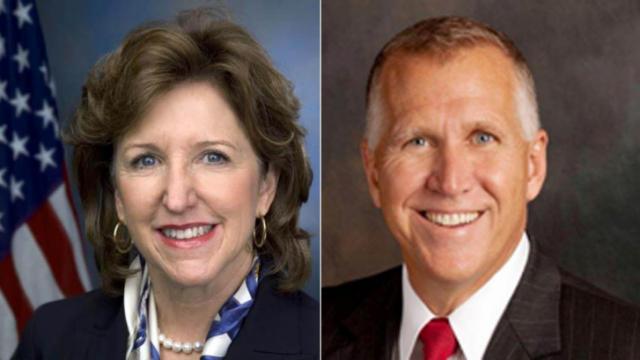
  • Kay Hagan and Thom Tillis

    Senator Kay Hagan and Speaker Thom Tillis

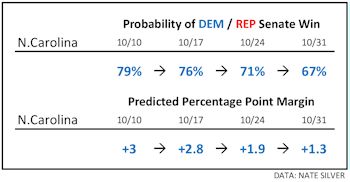
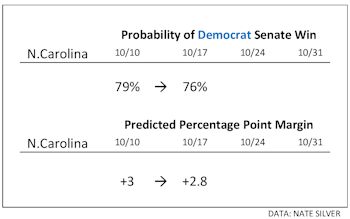
    North Carolina.  The NC Senate race, according to Silver, continues to tighten. As opposed to the 3-percentage-point margin he predicted 4 weeks ago, he has now shrunk Kay Hagan’s (D) margin over Thom Tillis (R) to 1.3 percentage points. He sees a 67% chance of a Hagan (D) win, which is down considerably from his 79% probability 4 weeks ago. The New York Times, Real Clear Politics, and Rasmussen are all leaning toward Hagan (D), and all currently see the gap at a whisker-thin 1 percentage point.
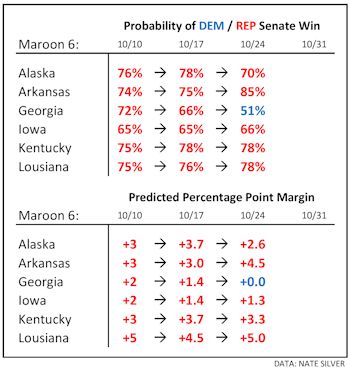
  • The Maroon 6.  Silver has switched his prediction in Georgia back to a win by David Perdue (R) over Michelle Nunn (D). This has significant ramifications for Silver’s “Maroon 6” concept. (See below.)The New York Times also now predicts this race is a 0.6 percentage point dead-heat, with a 57% chance of a Perdue (R) victory.

(Why keep an eye on Nate Silver? He’s the young probability/statistics guru who, unlike all of his peers in the business, correctly predicted the results of the 2008 Presidential race in 49 of 50 states, and the results of the 2012 Presidential race in all 50 states.)

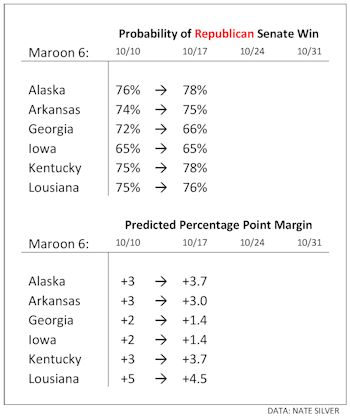
10-31_NateSilver_NCPrediction10-31_NateSilver_Maroon6In his construct of the Maroon 6. Silver has identified six states with Senate races he says are key to watch: Alaska, Arkansas, Georgia, Iowa, Kentucky, and Louisiana. His calculations tell him that if Republicans win all 6, they have a 99% chance to take the Senate. If they win 5, their chance slips slightly to 84%. With anything less than 5 wins, however, Republicans’ chances to control the Senate drop precipitously, to levels that strongly predict Democrats’ keeping the Senate. Right now, on his state-by-state predictions, he is showing Republicans ahead in all 6 — though the races in Iowa and Georgia are currently extremely close.

(Please note that when I use the shorthand “Silver predicts victory…,” I am saying that, in that race, his percentage probability of victory for that candidate currently sits at greater than 50%.)

Other Predictions:

  • The New York Times‘ online page TheUpshot page currently predicts: “According to our statistical election-forecasting machine, the Republicans have a moderate edge, with about a 69% chance of gaining a majority.” They predict an 68% likelihood that Kay Hagan (D) will defeat Thom Tillis (R), and they predict that the margin will be +1.1 percentage points for her. [These are down appreciably from last week, when Hagan was 79% likely to win by a predicted 2.4 percentage points.]
  • The Washington Post’s Election Lab states: “Republicans are favored to control the Senate. 95% chance as of today.” Currently they predict the GOP will begin 2015 with 52 seats in the Senate. In North Carolina, the Post gives Kay Hagan (D) a 77% chance of keeping her seat, which is appreciably smaller than their 95% prediction last week.
  • When forced to make best current predictions for all Senate races (including those they now call “toss-ups”) Real Clear Politics predicts a 7-seat net pickup by the Republicans, giving them a 52-48 majority. RCP’s average of polls currently predicts the following for North Carolina: Hagan (D) 44.1%, Tillis (R) 43%, and Haugh (L) 4.7%
  • Rasmussen Results is now showing Hagan (D) 47% over Tillis (R) 46% in their most recent polling. Hagan (D), therefore, has lost a percentage point since their previous poll, where the gap was 48% to 46%.

    That’s all until after the election.
Posted by: Dr. Grover B. Proctor, Jr. | 24 October 2014

Silver’s Crystal Ball, Part 3


This is Part 3 of a weekly series I am doing, tracking the 2014 political predictions of polling guru Nate Silver. (This is a stand-alone essay, but it’s possible you may wish to look at Part 1 and Part 2.) Here are the most important, and in some cases quite surprising, bullet points in his predictions as of today; details and expanded information are in the sections below.

  • National Senate Predictions.  Silver predicts there is a 60.7% chance that Republicans will win a majority in the U.S. Senate. The New York Times and The Washington Post both predict the same outcome, but with larger percentages.
  • North Carolina.  Silver predicts a 71% chance of Kay Hagan (D) defeating Thom Tillis (R). Currently he predicts a 48.1%-46.2% margin, the gap having shrunk to +1.9 percentage points. Two major polling and analysis organizations, Real Clear Politics and Rasmussen, have moved the race to the level of “toss-up.”
  • The Maroon 6.  Silver has moved Georgia from a close Republican win to an exact tie in the vote between Michelle Nunn (D) and David Perdue (R), 47.7% to 47.7%. He nevertheless lists a 51% chance that Nunn will win. (According to Silver’s Maroon 6 theory, this could significantly lessen the Republican’s probability of winning the Senate. See below for the theory behind the Maroon 6.) The New York Times also now predicts this race is a percentage point tie.

(Why keep an eye on Nate Silver? He’s the young probability/statistics guru who, unlike all of his peers in the business, correctly predicted the results of the 2008 Presidential race in 49 of 50 states, and the results of the 2012 Presidential race in all 50 states.)

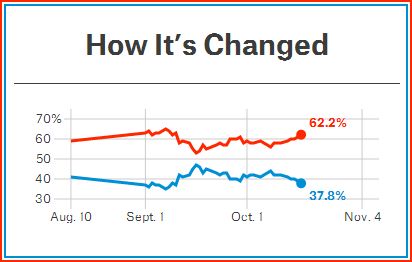
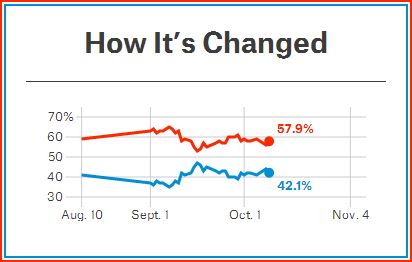
National Senate Predictions.  As seen in the “How It’s Changed” graph, Silver’s projection has contracted slightly this week for the GOP, predicting the probability of Republicans controlling the Senate now at 60.7%, down slightly from last week’s 62.2%.

Analysis and Graph by Nate Silver (24 Oct 2014)

Analysis and Graph by Nate Silver (24 Oct 2014)

Kay Hagan and Thom Tillis

Senator Kay Hagan and Speaker Thom Tillis

10-24_NateSilver_NCPrediction

North Carolina.  For the NC Senate race, Silver’s prediction of a Kay Hagan (D) win over Thom Tillis (R) has fallen to 71%, down from last week’s 76%. This is coupled with a much reduced predicted margin of victory, down to 1.9 percentage points, 48.1% to 46.2%. Two other major polling and analysis organizations have moved this race to the level of “toss-up.” (See “Other Predictions” section, below.)

(Please note that when I use the shorthand “Silver predicts victory…,” I am saying that, in that race, his percentage probability of victory for that candidate currently sits at greater than 50%.)

10-24_NateSilver_Maroon6

The Maroon 6.  Somehow, Silver is predicting that Georgia’s Senate race is exactly tied, 47.7% to 47.7%, but he has predicted a 51% probability that Michelle Nunn (D) will win. (I’m not sure how this math works, unless he is factoring in some sort of “trending” factor.) This prediction potentially has huge implications for Silver’s “Maroon 6” construct. He has identified six states that he calls the “Maroon 6,” with Senate races to watch: Alaska, Arkansas, Georgia, Iowa, Kentucky, and Louisiana. His calculations tell him that if Republicans win all 6, they have a 99% chance to take the Senate. If they win 5, their chance slips slightly to 84%. Given his current prediction of the Democrats’ taking Georgia, this theory automatically depresses the “Maroon 6 Prediction” of Republicans’ taking the Senate to 84%. Should Georgia and any other of the 6 states go to the Democrats, Republicans’ chances to control the Senate drop precipitously, to levels that strongly predict Democrats’ keeping the Senate. The table shows Silver’s current “Maroon 6” state predictions.

Other Predictions:

  • The New York Times‘ online TheUpshot page currently predicts: “According to our statistical election-forecasting machine, the Republicans have a moderate edge, with about a 67% chance of gaining a majority.” They predict an 79% likelihood that Kay Hagan (D) will defeat Thom Tillis (R), and that the margin will be +2.4 percentage points. [These are down slightly from last week, when Hagan was 81% likely to win by a predicted 2.9 percentage points.]
  • The Washington Post’s Election Lab states: “Republicans are favored to control the Senate. 91% chance as of today.” [This is down slightly from last week’s predicted 96% chance of a Republican win.] They continue to give Kay Hagan (D) a 95% chance of keeping her seat.
  • When forced to make best current predictions for all Senate races (including those they now call “toss-ups,” Real Clear Politics predicts a 6-seat net pickup by the Republicans, giving them a 53-47 majority. [This is down from their last week prediction of an 8-seat majority for the GOP.] They list the NC Senate race a “toss-up,” showing Kay Hagan’s (D) current margin over Thom Tillis (R) a mere +1.6 percentage points, up very slightly from last week’s 1.4 percentage point prediction.
  • There is no difference this week in the predictions by Rasmussen Results. They label the NC Senate race a “toss-up.” In their most recent poll (taken Oct. 6-7), Hagan (D) polled at 48% and Tillis (R) polls at 46%. The margin of error in that poll of likely voters was +/-3 points, placing these results within that range.

That’s all until next Friday.

Posted by: Dr. Grover B. Proctor, Jr. | 17 October 2014

Silver’s Crystal Ball, Part 2


In part 1 of this pre-election series, I re-introduced you to Nate Silver. He’s the young probability/statistics guru who, unlike all of his peers in the business, correctly predicted the results of the 2008 Presidential race in 49 of 50 states, and the results of the 2012 Presidential race in all 50 states. I remain quite curious to see how well he will do in these off-year elections.

This is the first of the four Friday updates to my initial article, leading up to Election Day, to see how Silver’s Senate election predictions evolve, if they do — and, afterwards, to see how much he got right.

Last week, Silver’s projection was a 58% likelihood that Republicans will win control of the Senate this election.

As seen in the graph, this week his projection has widened the chance for the GOP. He now sees a 62.2% likelihood that Republicans will control the Senate, and only a 37.8% chance the Democrats will keep it.

Control of Senate Probability Predictions

Analysis and Graph by Nate Silver (17 Oct 2014)

Kay Hagan and Thom Tillis

Senator Kay Hagan and Speaker Thom Tillis

North Carolina Senate Projection Percentages
In the North Carolina race, Silver is still predicting a 47.5-44.7 percentage point Kay Hagan (D) victory over Thom Tillis (R). However, he has lessened ever so slightly the probability of that win from 79% to 76%.

(Please note that when I use the shorthand “Silver predicts victory…,” I am saying that, in that race, his percentage probability of victory for that candidate currently sits at greater than 50%.)

Of the 36 Senate races being decided (including special elections in Hawaii, Oklahoma, and South Carolina), Silver’s predictions are unchanged since last week, showing Republican wins in 22 states and Democratic wins in 14. These include 8 Democrat-to-Republican pick-ups in Alaska, Arkansas, Colorado, Iowa, Louisiana, Montana, South Dakota, and West Virginia. The only Republican seat he is predicting they will lose is in Kansas.

Maroon 6 States Predictions
The Maroon 6: Silver has identified six states that he calls the “Maroon 6,” with Senate races to watch: Alaska, Arkansas, Georgia, Iowa, Kentucky, and Louisiana. His calculations tell him that if Republicans win all 6, they have a 99% chance to take the Senate. If they win 5, their chance slips slightly to 84%. With anything less than 5 wins, however, Republicans’ chances to control the Senate drop precipitously, to levels that strongly predict Democrats’ keeping the Senate. Right now, on his state-by-state projections, Silver’s predictions of Republican victories in all 6 of the Maroon states remains unchanged, though he says the race has tightened slightly in Georgia.

Other Predictions:

  • The New York Times‘ online TheUpshot page currently predicts: “According to our statistical election-forecasting machine, the Republicans have a moderate edge, with about a 70% chance of gaining a majority.” They predict an 81% likelihood that Kay Hagan (D) will defeat Thom Tillis (R), and that the margin will be +2.9 percentage points.
  • The Washington Post’s Election Lab states: “Republicans are favored to control the Senate. 96% chance as of today.” They give Kay Hagan (D) a 95% chance of keeping her seat.
  • When forced to make best current predictions for all Senate races (including those they now call “toss-ups,” Real Clear Politics predicts an 8-seat net pickup by the Republicans, giving them a 53-47 majority. They list the NC Senate race a “toss-up,” showing Kay Hagan’s (D) current margin over Thom Tillis (R) a mere +1.4 percentage points.
  • Rasmussen Results currently labels the NC Senate race a “toss-up.” In their most recent poll (taken Oct. 6-7), Hagan (D) polls at 48% and Tillis (R) polls at 46%. The margin of error in that poll of likely voters was +/-3 points, placing these results within that range.

That’s all until next Friday.

Posted by: Dr. Grover B. Proctor, Jr. | 15 October 2014

A Modest (If Slightly Tongue-in-Cheek) Proposal


Lawyers acting on behalf of Houston Mayor Annise Parker last month issued subpoenas to “several high-profile pastors and religious leaders” demanding they turn over to the government “all speeches, presentations, or sermons related to HERO [the Houston Equal Rights Ordinance], the Petition [to put HERO on the November ballot so that the people could vote it up or down], Mayor Annise Parker [yes, as she clearly said, “The debate is about me.”], homosexuality, or gender identity prepared by, delivered by, revised by, or approved by you or in your possession.”

Now, some people have found Mayor Parker’s subpoenas to be a chilling harbinger of a potential violation of the 1st Amendment rights of these clergy. And on first glance, it appears that might be the case. But this is America, and certainly no government official would ever violate the Constitutional rights of the citizenry. Right?

Mayor Annise Parker and friend

Mayor Annise Parker and friend

Let’s review the things the Mayor is Constitutionally forbidden to do — and which, therefore, I am certain she would never do (he said, with all the innocence of the truly naive). In a mere 45 words, the Constitution’s 1st Amendment guarantees the following:

  • The government (and thanks to the 14th Amendment, this includes state and city governments) cannot set up (establish) a national or state or city religion. (This is known as in legal circles as “The Establishment Clause,” not “The Separation-of-Church-and-State Clause.” More on that important distinction in a future essay, perhaps.)
  • Nor may the government coerce Americans (including the clergy who received the subpoenas) concerning what their religious beliefs may or may not be.
  • The government may not keep them from exercising those religious beliefs, in whatever ways those beliefs require.
  • And the government may not prevent them from saying or publishing whatever they wish about those religious beliefs (or anything else, for that matter).
  • Not that it could happen in America, but if these religious people felt that elements in government were, hypothetically, sending out subpoenas maliciously in an attempt to do any of the things listed above that government cannot do, those religious people have the right to band together (an example of which, chosen completely at random, might be a national organization like the Alliance Defending Freedom).
  • And finally, that freely banded-together group has every right to demand that the government stop violating its members’ rights and leave them the heck alone. (Pardon my french.)

Since she would never violate any of the above prohibitions, clearly there must have been some other, totally benign reason that the Mayor subpoenaed those sermons.

I prefer to believe that she must have demanded all of these documents in order to read, learn, and educate herself on the arguments coming from all diverse sides of these issues. And not just the issues; this would include her sincere desire to know how her constituents feel about her personally (“The debate is about me.” ), so that she can most effectively represent all of the diverse communities in Houston. Thus, she must be demonstrating how much she values the ministers’ convictions, only issuing the subpoenas as the easiest way to demonstrate how eagerly and quickly she wants to be more informed and to make inclusive judgments which follow the will of the people.

My Modest Proposal.   With all of the above in mind, therefore, I propose that every deacon, pastor, parson, preacher, minister, priest, rector, missionary, chaplain, evangelist, cleric, prelate, curate, elder, dean, bishop, abbot/abbess, monsignor, archbishop Sunday/Sabbath School teacher, and Vacation Bible School leader from every church in the entire nation send to the Mayor every sermon, tract, monograph, bible study, book chapter, interview transcript, radio and tv program, and even jottings on a paper napkin they’ve ever done, which even remotely touch on the subjects included in the Mayor’s subpoenas.

Send one item per envelope or email. This will get her staff’s attention, and let them know unambiguously how sincere you are in your support of the Mayor’s self-educational endeavors. Or, if you prefer, call and give an unhurried, detailed reading of these documents over the phone. I’m providing the contact information below to help you assist the Mayor in accomplishing her personal goal to be educated about and tolerant of all points of view:

          Mayor Annise Parker, 901 Bagby Street, Houston, TX 77002
          Phone: (713) 837-0311
          Email: mayor@houstontx.gov

Oh, and in each communication, be sure to tell the Mayor how glad you are that she is not abusing the 1st Amendment rights of your fellow Christians, and just how angry (perhaps even litigious) you would become if any government official ever tried to do so.

Let me know how this works for you!

A Postscript for all fans of the television show The Big Bang Theory:
Sheldon, before you ask… Yes… Everything I said above about the Mayor’s actions and motives do fall under the Constitutionally protected category of sarcasm.

Posted by: Dr. Grover B. Proctor, Jr. | 10 October 2014

Silver’s Crystal Ball


Nate SilverAnyone remember Nate Silver?

Of course you do — or at least you should. He is the 36-year-old statistician who did what no other pollster or analyst seemed able to do: he accurately predicted the 2008 Presidential voting results in 49 of 50 states (Indiana tripped him up by 1 percentage point); and in 2012, when all other pollsters missed (Republican Party polling disastrously so), Silver correctly predicted the results in all 50 states.

So, with exactly 25 days left until election day, what is the stats wunderkind saying about the 2014 mid-terms?

Silver is not a pollster, nor does he commission polls from others. He obtains the results from existing professional, journalistic, and university polling organizations, he combines and analyzes their results, and he uses those results to make his own probability-based predictions. His genius is in (1) the relative weightings he gives each source, and (2) the (closely guarded) secret of how he has determined those weights and how they can translate into highly calibrated probabilities.

Silver’s latest graph (from last night; shown below) plots the evolution of his predictions of the likelihood of control of the Senate (Dem blue vs. Repub red), beginning back on August 10. As of right now, Silver’s projection is that there’s a 58% likelihood that Republicans will win control of the Senate, with only a 42% chance that the Democrats will keep it.

Control of Senate probability predictions

Analysis and Graph by Nate Silver


Kay Hagan and Thom Tillis

Senator Kay Hagan and Speaker Thom Tillis

In the North Carolina race, he is currently predicting a 48-45 percentage point Kay Hagan (D) victory over Thom Tillis (R). He calculates a 79% likelihood of her winning, and a 21% chance of a Tillis win. (Please note that when I use the shorthand “Silver predicts victory…,” I am saying that in that race, his percentage probability of victory for that candidate currently sits at greater than 50%.)

Of the 36 Senate races being decided in 25 days (including 3 special elections in Hawaii, Oklahoma, and South Carolina), Silver is currently predicting Republican wins in 22 states and Democratic wins in 14. These include 8 Democrat-to-Republican pick-ups in Alaska, Arkansas, Colorado, Iowa, Louisiana, Montana, South Dakota, and West Virginia. The only Republican seat he is predicting they will lose is in Kansas.

The Maroon 6: Silver has identified six states that he calls the “Maroon 6,” with Senate races to watch: Alaska, Arkansas, Georgia, Iowa, Kentucky, and Louisiana. His calculations tell him that if Republicans win all 6, they have a 99% chance to take the Senate. If they win 5, their chance slips slightly to 84%. With anything less than 5 wins, however, Republicans’ chances to control the Senate drop precipitously, to levels that strongly predict Democrats’ keeping the Senate. Right now, on his state-by-state predictions, Silver is predicting Republican victories in all 6 of the Maroon states:

Alaska 76% chance of R win predicting win by 3 pct. points
Arkansas 74% chance of R win predicting win by 3 pct. points
Georgia 72% chance of R win predicting win by 2 pct. points
Iowa 65% chance of R win predicting win by 2 pct. points
Kentucky 75% chance of R win predicting win by 3 pct. points
Louisiana 75% chance of R win predicting win by 5 pct. points

 
Because he has a history of being uncannily correct, and because he was in the right place at the right time to call major Democratic Presidential wins, he has emerged as that party’s darling — almost a talisman or harbinger of Blue victories. But I understand he is taking flak this year from some Left/Liberals for his predictions about the Senate races. Some attacks have been so shrill it sounds as if they’re saying, “How dare you predict bad things for us?!”

As we all know, there is always the possibility of one or more major October Surprises, and polling data fluctuate all the way up until the day of the selection. So on the next 3 Fridays before the election, I will give an update here on the evolution of seer Nate Silver’s projections, and then I will do a “how did he do?” review after the election.


Posted by: Dr. Grover B. Proctor, Jr. | 26 August 2014

No ‘King Rules’ in Wake County Libraries


Dr. Alveta KingThe Wake County (NC) Public Library System wrote to me today to tell me that they have refused to purchase any copies of the latest book by the niece of Dr. Martin Luther King, Jr. — Dr. Alveda King’s book King Rules: Ten Truths for You, Your Family, and Our Nation to Prosper. I have to say I was simultaneously disappointed and dumbstruck.

Based on what criteria, you may well ask, did they decide not to buy a single copy? In the email I received, they suggested Dr. King’s book failed on criteria such as “ongoing rather than short-term interest, positive/favorable professional reviews, existing need, qualifications of author, appropriateness for a public library with a general audience.” Seriously?

What, one wonders, did they find deficient or objectionable — the author or her book?

King RulesDr. King is described as a “Guardian of the King Family Legacy.” She is a Christian Minister, “a grateful mother and grandmother, a former college professor, author, mentor, stage and screen actress, Georgia State Legislator and presidential appointee.” She runs Alveda King Ministries, and she “devotes her God-given gifts and talents of writing, singing, song writing, producing and directing media projects and other gifts to glorify God in the earth.”

Like Dr. King herself, the book is courageous and insightful, described by Dr. Ben Carson as a volume that “places renewed emphasis on the importance of the family as a principal source of values, and as a fortress against societal erosion. This is a refreshing look at the forces that led to the greatness of Dr. Martin Luther King Jr., and that can lead to success in our lives.”

So what did the Library buy in 2014 in place of King’s Rules? Since the beginning of the year, the Library System has added multiple copies of the following books to its shelves — which they apparently found to be of more ongoing interest, with more favorable professional reviews, written by a more qualified author, and meeting more of a need than Dr. King and her book:

  • Get the Scoop on Animal Puke! : From Zombie Ants to Vampire Bats, 251 Cool Facts About Vomit, Regurgitation, & More! (17 copies)
  • Hades Speaks! : A Guide to the Underworld by the Greek God of the Dead (17 copies)
  • Bathtime Buddies: 20 Crocheted Animals from the Sea (13 copies)
  • The Marshmallow Test: Mastering Self-Control (13 copies)
  • Waking Up: A Guide to Spirituality Without Religion (13 copies)
  • Glitterville’s Handmade Christmas: A Glittered Guide for Whimsical Crafting! (13 copies)

Seriously?

The video trailer for the book is below. My suggestion about King Rules? Read it joyfully, prayerfully learn from it, and be inspired by it — despite the Wake County Library System’s failure to help you do so.


Posted by: Dr. Grover B. Proctor, Jr. | 17 June 2014

FilmWatch: A Thousand Years of Good Prayers


For those of you living in central North Carolina, I encourage you to attend the Cary Theater’s showing of director Wayne Wang’s award-winning 2007 film A Thousand Years of Good Prayers. I have not seen the film, and it is not rated — so I can’t warn you if there are any objectionable scenes or dialogue. But the critics, while not unanimous, were largely very favorable toward it. I have added a couple of excerpts from reviews below, and you can read the entirety of Roger Ebert’s thoughtful, sensitive review here. And by the way, if you can’t see the film at The Cary, you can still view it. Read on.

Yiyun Li and Wayne Wang

Yiyun Li and Wayne Wang

The film is an adaptation of a short story by celebrated author Yiyun Li, from a collection of stories by the same name, which won the Frank O’Connor International Short Story Award, PEN/Hemingway Award, Guardian First Book Award, and California Book Award for first fiction. Salman Rushdie was moved to write of her work, “The surface of Yiyun Li’s prose is deceptively still, but just beneath the surface is sadness, pain and tragedy. Her characters are portrayed with a harsh beauty, and one’s emotions become deeply engaged with their fates.”

Wayne Wang has directed such films as The Joy Luck Club, Chinese Box (starring Jeremy Irons and the incomparable Gong Li), Because of Winn-Dixie, and the exquisite Eat a Bowl of Tea. To cite Roger Ebert again, “I suppose you could say that Wayne Wang is our leading Chinese-American filmmaker, but I despise descriptions like that. He’s a fine filmmaker, no labels needed.”

The Cary Theater’s showings will be on July 10 at 7:00 and 9:30 pm and July 13 at 2:00 pm. If you cannot come to Cary to see it, A Thousand Years of Good Prayers is available on Netflix direct streaming.

A Thousand Years of Good Prayers

METACRITIC RATING: 64 (out of 100)

Genre:   Drama | Romance
Directed by:   Wayne Wang
Running Time:   83 minutes
Language:   English | Mandarin | Persian
Starring:   Henry O, Yu Feihong (Faye Yu), Vida Ghahremani
Rating:   Not rated in America

Family ties bind us together in visceral ways, but the forces of modern life often seem to drive parents and children apart. Elderly Mr. Shi, a widower and a retired scientist, has arrived from Beijing to spend time with his divorced daughter, Yilan. He hopes to help her sort out her life in this strange new country. Though his trip starts off as a mission to see his daughter remarry, he sparks to an Iranian woman who, despite their language barrier, captures his heart. (Magnolia Pictures)

88 (out of 100) Chicago Sun-Times Roger Ebert:
Mr. Shi (Henry O) gets off his flight in San Francisco and looks around for a daughter who should be waiting for him. Yilan (Faye Yu) is a little tardy. She has not seen her father in years, yet does not kiss him. She takes him home to her antiseptic condo. As they have dinner, silences threaten to overwhelm them. He is reluctant to pry too much. She is guarded…. In observing the reality of this relationship, Wang contemplates the “generation gap” in modern societies all over the world. His film quietly, carefully, movingly observes how these two people of the same blood will never be able to understand each other, and the younger one won’t even care to. And if you’re not near Cary, there’s a way for you to still see it. Read on.

80 (out of 100) Los Angeles Times Kevin Thomas:
Rich in revealing detail and apt in its use of everyday Spokane settings, A Thousand Years of Good Prayers shows that Wang remains a master explorer of the landscape of the human heart.


The Cary Theater

The Cary Theater
122 E. Chatham Street
Cary, NC

Built in 1946, The Cary Theater property was once home to the town’s first indoor movie theater, which hosted live performances as well as films. The site has since been used as a clothing store, auto parts store, and recording studio. Now the marquee lights up Downtown Cary with the mission of providing a unique, 175-seat venue for classic and independent films, music, and live performance including comedy and improv. The Cary Theater is a program of the Town of Cary’s Parks, Recreation & Cultural Resources Department. (Click photo or address above to see a Google Map of location.)

Posted by: Dr. Grover B. Proctor, Jr. | 24 December 2013

Living a One-Buttock Life


One of my cousins once questioned me when I said that a certain person was “one of my heroes.” She wondered if that person merited such a lofty title, and I saw what she meant. When I say that, I am not suggesting that the person has superhuman qualities ascribed to heroes of literature or mythology. (Sorry, Achilles and Clark Kent.)

When I use that phrase, I’m appropriating the first two definitions that Merriam-Webster provides: “a person who is admired for great or brave acts or fine qualities; a person who is greatly admired.”

Having said that, one of those true heroes of mine is Benjamin Zander, who has distinguished himself as a conductor, musician, teacher, author, inspirational speaker, and evangelist for classical music. I refreshed myself this week by going back and revisiting his Ted talk video from 2008, in which he boldly asserts and effectively proves that everyone can love, understand, and be moved by classical music. (“Classical music is for everybody. Everybody!“)

At the very least, his infectious enthusiasm and raconteur genius is worth investing 20 minutes of your time, and I urge you to do so below. Don’t let the specter of that horridly foreign thing called “classical music” keep you from watching this video. Allow Zander to entertain you, make you laugh, get you excited, and touch your heart.

The Art of PossibilityHaving watched Zander, you now know about “one-buttock playing.” Let me encourage you to further your understanding of how this concept — as well as others such as “Giving an A,” “Rule Number 6,” and “Leading from Any Chair” — can be life-transforming as expounded in the book The Art of Possibility, by Benjamin Zander and Rosamund Zander. (Check it out from your library, or click on the graphic of the book’s cover art at right to find out how to own it.)

Though he might not put this on his professional bio, I’ve found Zander’s message about achieving possibilities in others to be, at its root, an analog to the Christian doctrine of the loving servant (Mark 10:44-45). You’ll know what I’m talking about at roughly the 18:00 mark of the video, when Zander shares how we can know if we are encouraging possibilities in others. You can tell, he says, when you see their eyes light up, which is something a conductor should look for in the orchestra’s players. “If the eyes eyes are not shining, you get to ask a question: Who am I being that my players’ eyes are not shining?”

From the book’s publicity blurb: “The Zanders’ deceptively simple practices are based on two premises: that life is composed as a story (‘it’s all invented’) and that, with new definitions, much more is possible than people ordinarily think. The book shifts our perspective with uplifting stories, parables, and anecdotes from the authors’ person experiences as well as from famous and everyday heroes.”

And so, we come back around to the subject of heroes. I’ll write more about other heroes of mine in the future.


« Newer Posts - Older Posts »

Categories