
Posted by: Dr. Grover B. Proctor, Jr. | 27 April 2016

The King & the Curmudgeon


Adrianne and I went to the movies last night and saw Elvis & Nixon, a truly marvelous little film. Except by word of mouth, I fear it unfortunately won’t get much publicity. I mean, had you heard of it before now? But for sheer entertainment value, I give it a 9 out of 10.

The trailer (below) nicely sets the stage for this 87-minute gem. Kevin Spacey is phenomenal (when is he not?), and Michael Shannon (General Zod in the Superman movies; film debut as Fred in Groundhog Day) gives a portrayal of Elvis that I think even the King himself would have approved.

Anyone with memories of either Elvis “the King” Presley or Richard “I am not a crook!” Nixon should make an effort to see it.

As a former student of the Watergate affair, I was also entertained by the film’s portrayals of soon-to-be-convicted-felons Egil “Bud” Krogh (Colin Hanks), Dwight Chapin (Evan Peters), and H.R. Haldeman (Tate Donovan). After Elvis has come to the White House seeking a meeting with Nixon, Krogh and Chapin fly into Haldeman’s office, telling him he’ll never believe who just showed up. Haldeman demands, “Who?” “The King,” says Krogh. Ever-literal Haldeman barks back, “He doesn’t have any meetings with royalty today!” Krogh: “No. THE King!”

The soundtrack was a joy, as well, pulling original songs from the period with subtle meaning for the plot. At the beginning of Elvis’ quest to meet the President, Sam and Dave alert us to “Hold On, I’m Coming!” And when word comes back from the White House that Nixon had initially denied the request, Elvis announces he needs to go out for some air. That poignant moment happens to the voice of Sister Rosetta Tharpe singing “There Will Be Peace in the Valley For Me.” Elvis’ cover of that recording became my mother’s all-time favorite song of his, and one of his most highly acclaimed records. Did you know that the only Grammy Awards Elvis ever won were for his Gospel recordings? Just another example of attention to detail, demonstrating that the filmmakers certainly did their homework.

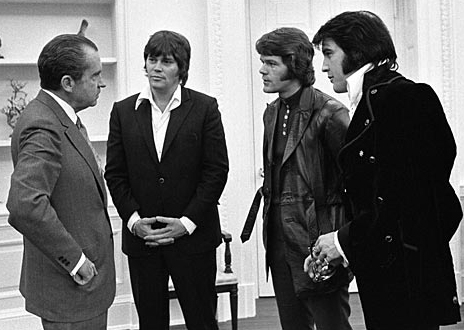
Elvis & Nixon (real)

The film captured this moment so accurately in detail that I had to look twice to be certain if this photo was the real encounter or its re-make. Of course, it’s real.

The critics have been somewhat mixed in their reactions to Elvis & Nixon, but with an obvious lean toward the positive. It has a 59 (out of 100) Metacritic rating, but a significantly higher 76% rating from Rotten Tomatoes.

My usual go-to critic, Joe Morgenstern of The Wall Street Journal, seems (in my opinion, at least) to have missed the caricaturish, political-fairy-tale-like point of the film. He wrote that “it’s a reasonably clever contrivance built around a pair of droll, skin-deep performances that are smart and entertaining, yet oddly lacking in intensity.” In the entire time I was watching the film, I never once pined for more intensity.

Richard Roeper of the Chicago Sun-Times gave the film its strongest accolades: “How was this not a movie before now? The good news is, it was worth the wait. Elvis & Nixon is one of the most entertaining movies I’ve seen this year — a whip-smart slice of strange history bolstered by pitch-perfect period-piece references, two excellent, offbeat performances and a brisk sense of pacing. Even the screenplay credits are appropriately surreal.”

(A small warning: it’s rated R for “some language” — mainly, I think, for Bud Krogh’s quietly, frantically, and comically dropping the f-bomb under his breath when reacting to Nixon’s eccentricities.)

Posted by: Dr. Grover B. Proctor, Jr. | 15 March 2016

Cracker Barrel Conundrum


Cracker Barrel logo

Have you ever eaten at one of the Cracker Barrel Restaurants that dot our Interstate Highway system?

If so, you’ve no doubt spent at least a few minutes contemplating (maybe even trying) the peg puzzle game that is found on every table. For the longest time, I never actually won a game on one of those things, leaving me to feel woefully intellectually deficient. Phooey.

KEEP READING. I got very curious about the puzzle, and over the last few weeks I put my computer programming skills to work and have uncovered some very interesting things about it, which I’ve shared below.

Peg Puzzle GridBefore My Findings, Here are the Rules. The rules are simple enough. You are asked merely to “jump each peg and remove it” from the board, staying in a straight line for your move. Obviously, you must have a single empty slot at the start of each game (else, where would your first jump land?), and you may select whichever slot you desire to be empty. (This, as it turns out, will be crucial for a greater chance of winning.)

In the game board shown here, there are actually only 2 possible first moves. You may pick up the peg in slot D, jump over E, place the peg in J, and remove the peg from slot E. Or, you may pick the peg in slot B, jump O, and place it in slot J, removing the peg from slot O. Either way, there are now 2 empty slots — either D and E or B and O.

To win the game, you must continue to make similar moves until there is only 1 peg remaining on the board. Simple, eh? Well, not so fast. The rules of the game are simple, but a winning strategy is anything but simplistic. Maybe you need to know a little more about the game.

A Little More About the Game. I started by wondering if there was some sort of pattern or “secret knowledge” that would help solve the peg problem. So I wrote a computer program that generates every possible unique game (that is, every sequential set of legal moves), then plays each game, and finds out how many of them lead to a “win.” (If you’re interested in the logic I used to generate every move and to analyze every game, I’ve added a slightly more technical postscript to the bottom of this post.)

Here’s what I found about trying to end the game with one single peg on the board after 13 moves:

  • There are 7,335,390 possible, unique games.
  • Of those, 438,984 produce wins. That means 6% of all possible games result in a win.
    (Yes, I have a complete, move-by-move list of all 438,984 winning games. If you are interested in seeing that list, send me your email address and I’ll post a .TXT file back to you. But be careful what you ask for; it’s a 27.7-meg file!)
  • Which initial empty slot should you select? Choosing the middle slot on one of the outside line of slots, (C, H, or M, as labeled in the graphic above) greatly increases your chance of winning. 58% of all possible wins started with one of those three slots empty. 20% of all possible wins started with an empty slot in one of the corners, A, F, or K.
  • The least effective choice for the first empty is one of the interior slots (E, J, or O). These positions account for only 1% of all wins — so it’s possible, but highly unlikely. Are you challenged to try to find one or more of the 4,650 winning games that start in one of those interior empty slots?

By the way, my program took a mere 2 minutes 15 seconds to create, play, and analyze all 7+ million games on my six-year-old Dell laptop. That works out to 54,084 games played per second and 3,237 wins per second. That surely beats sitting there and pulling up and pushing in pegs for 7 millions games!

Other Ways to Win? Ending with only one peg on the board is the “official” way to win the puzzle. But who says we can’t define our own ways? While researching online what others thought of the puzzle, I came across one man’s post which said: “Leaving one peg is easy. I’m looking for the solution to leaving one peg in all three corners. Anyone know how?”

Well, never let it be said I shied away from a challenge. I only had to make two changes to the program I had already written in order to get his answer. (First, change the number of moves from 13, which leaves 1 peg, to 11, which leaves 3 pegs. Then, change what constitutes a “win” — from 1 peg anywhere on the board to 3 pegs, 1 in each corner.)

I began with the “3-Corner Win” challenge (number 1 below). Afterwards, I invented some more of my own alternate “win scenarios” (illustrated by the other grids) just to see what possibilities each might present. Since all of these “new ways to win” end with 3 pegs on the game board, each of them has the same number of possible, unique games — 6,765,402.

Here’s what I found out about these alternative games. (Each item in the numbered list refers to the corresponding numbered peg board graphic shown below.)

Peg Problem - 11-move games

  1. 3-CORNER WIN. This is the challenge put forward by the peg game enthusiast above — one that results in “leaving one peg in all three corners.” I was sad to have to report to him that the computer proved there are no ways to play the game and end with 3 pegs in that configuration.

  2. 3-MIDDLE WIN. Here, the goal is to leave a peg in each of the three middle or interior slots. As in the 3-Corner game, there are no ways to win.
    3-MIDDLE-EMPTY WIN. However, if we change this definition of a “win” slightly, we are rewarded with a much simpler game. What if, instead of wanting to finish with all three of the interior slots filled, we play trying to leave all three interior slots empty, with three pegs anywhere else on the board? Of the 6,765,402 possible games, a whopping 4,055,706 will produce a win! That’s just a whisker under 60%!
    Where should our initial empty slot be in order to insure the greatest likelihood of success? Once again, selecting the middle slot on one of the outside line of slots is best, as 28% of all winning games started that way. The next most successful pick would be one of the three corner slots. They account for 14% of winning games. By far the least successful are any of the three interior slots.

  3. 3-OUTSIDE-LINE WIN. Here’s the first of a series of definitions for a “win” which actually provide three possibilities for a win. The goal here is to leave 3 consecutive slots filled on the outside of the grid, not including one of the corners. Graphic 3 above shows one of the possibilities. A win could either be there, or across the top, or down the right side. It doesn’t make any difference, however, because once again there are no ways to win.

  4. 3-CORNER-CLUSTER WIN. As before, there are three possibilities for meeting the objectives of this “win.” The goal is to leave a peg in the 3 slots clustering at the tip of each corner. Shown is the upper left corner, but one could win in the upper right corner or the lower corner. Too bad if you had your heart set on doing this one, as, (say it with me) there are no ways to win.

  5. 3-LINE-BISECTER WIN. Cheer up! We’ve found another winner, though it will give you a true challenge. In this one, you want to finish with a straight line of 3 pegs, starting at a corner and going straight across to the middle slot of the opposite line. Since there are 3 corners, there are three possible ways to win this. Out of the 6,765,402 individual games, there are an even 30,000 winning games. That’s a measly 0.4%. Do you think you can find one of those 0.4%? (In the technical notes at the bottom of this post, I have given you the move-by-move solution for 1 of those 30,000 winning games, which I pulled randomly from the list.)

  6. 3-CORNER-LINE WIN. This final “win” definition calls for three pegs in a row at the base of one of the corners. The illustration above shows the upper right corner, but it could equally be the upper left corner or the bottom corner. For one last time, I am forced to tell you that there are (wait for it) no ways to win.

If you have any other possible “win” configurations — any pattern / any number of pegs left — that you would like me to submit to my computer program to see if there really are any wins possible, just write it in a comment. I’ll get back to you with an answer.

Good luck with your Peg Puzzlements!


Peg Game - Cracker Barrel instructionsIf you’re just itching to get a winning 13-move game, leaving only 1 peg on the board, here’s your booster seat. These are the instructions Cracker Barrel provides when you buy one of their wooden Peg Game boards — or the “Old Fashioned Peg Game,” as they call it.

Remember, there are 438,983 other ways to win. (Cracker Barrel understates it by saying there are “many more ways to work this game.”) So start now, and maybe by Thanksgiving you’ll find ’em all.

 
Below is a screen shot of my computer program after completing the testing the 3-Corner win scenario. (Click on the image to see a larger version, for easier reading.)
 
Peg Problem computer screen


A Few Slightly Technical Notes About Testing the Peg Problem

Each Peg Puzzle game you play starts with choosing an initial empty slot. Based on that, I began with empty slot A, calculated what the legal moves were from that point, and had the computer “make” each of those moves. That was “move 1” of all the empty-slot-A games. Next, the computer branched out from the “move 1’s” and calculated and made all the possible “move 2’s” from there. Then the “move 3’s,” “move 4’s,” etc., for whatever total number of moves was required for the problem I was solving. If a “win” leaves 1 peg remaining, that requires 13 moves. If 3 pegs are needed for a “win,” that requires only 11 moves. (Of course, many games end before the maximum number of moves is met because there are no more legal moves.) This succession of move 1’s, then move 2’s, 3’s, etc., creates an expanding branching or tree effect for each initial empty slot location. When the program completes the entire full set of moves and games that began with empty slot A, it moves on to slot B, then slot C, etc. and completes the same tree-making process for each. When the computer runs through all required initial empty slots, it has generated and played every possible game. The program then reports to me how many possible games there are and, more important, how many wins arise from those games.

The program I wrote does 3 major things: (1) it generates and counts all possible, unique games (i.e., series of legal moves) for the board, based on where the initial empty slot is placed; (2) it plays each game strictly by the rules to its logical conclusion; and (3) it counts the number of wins achieved (however “win” is defined) and records each winning game’s moves. All other numbers, statistics, and conclusions are derived from these three processes. The backbone of all of this comprises several algorithms I created, including one to test the game board, whatever its current configuration of pegs and empty slots, and identify how many legal moves there are and what those moves are.

Peg Problem - 3-Mirror GridYou may have wondered about the seemingly haphazard way I assigned letters to the slots on the game board. (See graphic at the top of this page.) Because the game board forms an equilateral triangle (all three sides equal in length), you can turn it 120 degrees to the left or to the right, and you are looking at an identical grid of slots. Using that fact, it was easy to divide the 15 slots into 3 groups that also mirror one another, no matter which way you turn the board. This is shown by the areas colored in yellow, blue, and green in the graphic at the left. Let’s consider the move where you pick up the peg in A, jump the peg in B, place it in the empty slot C, and then remove peg B. Turn the game board 120 degrees counterclockwise. Note that the move pick up F, jump G, place in H, and remove G is identical to your previous move. It will be the same for the slots K-L-M. What this fact means for testing games of the Peg Puzzle is that you only have to test one-third of the initial empty slots. (For convenience, I choose to test initial empty slots A-E.) So in almost all cases, I merely have to find all the possible games that have slots A, B, C, D, and E as initially empty, find out how many winning games we get from those games, and multiply by 3 to determine results for the entire board.

3-Peg ProblemThis is the sample winning game I promised from the “3-LINE-BISECTER WIN” (number 5) section above. If you want to test it, to see how it gets to the desired “win,” here’s what you do. Label the slots on your peg puzzle board the same way shown in the graphic at the top of this post (A through O) — it won’t work otherwise. Then, put the 14 pegs in, leaving the C slot empty. Each group of 3 letters below is a move, and you play it this way: the first move is FDC, which means take the F peg, jump the D peg, and place it in the C slot. Remove the D peg. Keep going with each 3-letter group through the end.

Empty slot C — FDC BCD MOC IJO DCB GHI KIH ANM MLK BOJ HEC

Using the set of moves I’ve given you above, the final 3 pegs are in slots C, J, and K, the same as shown in the graphic. Of course, you could win with either of the other “Line Bisector” possibilities: A-O-H or F-E-M. Can you find the remaining 29,999 winning games? 🙂

PEG PROBLEM PROGRAM COMPILED IN QB64, v.1.000 TO RUN IN WINDOWS ENVIRONMENT
 
Posted by: Dr. Grover B. Proctor, Jr. | 13 February 2016

The Red Door House


Adrianne and I were sitting at home in front of the television on January 26, settled in to watch a new episode of one of our most favorite programs — when, almost simultaneously, our jaws dropped and our eyes opened wide in total astonishment.

There, on the screen, was Adrianne’s grandparents’ Waco, Texas, house, where her father had grown up.

The show was Fixer Upper on the HGTV network, hosted by the engagingly talented husband-and-wife duo Chip and Joanna Gaines. We have been fans of the series since we first heard about this wonderful pair of Waco home renovators, both graduates of Baylor University. (Adrianne, like her father before her, is an alum of Baylor. And I confess to have fallen in love with both the school and the city during our trips there.)

In case you are one of the five or six people in the country who have not seen the show, the premise is that Chip and Joanna show prospective home buyers three possible houses (inside and out) that need varying degrees of work. All three are within the purchaser’s budget, with enough money left over for the needed renovations. The home buyers select one of them, and for the rest of the show we get to see contractor Chip and designer Joanna work their collective magic.

3025 Cumberland Ave

In this episode, Adrianne’s grandparents’ house, which was given (for obvious reasons) the nickname “The Red Door House,” was the third among those shown to the young couple. Searching for their first home, the couple ultimately did not choose “Adrianne’s” house, but we thoroughly enjoyed seeing their walk-through.

Adrianne and her family visited there when she was about six years old, and she says she remembers the fan light over the front door and the space under the stairs in the entry hall, where she sat to do embroidery. It also brought back memories of playing the card game War with her older brother in the living room, and helping to polish apples that were in a bowl on the coffee table. (See photos below. There are not, alas, any of a six-year-old Adrianne embroidering.)

Each time during our various trips back to Waco in the last several years, we drove by and spent time looking at the exterior of the house. Those visits were special for Adrianne, and were also the reason that we were able to recognize the house immediately when it came on the screen.

The Red Door House

This episode’s buyers, Jeff and Sara Jones, are Baylor graduates and newlyweds, returning to Waco to buy their first house. When they drove up to the Red Door House, Sara exclaimed, “Cute! Oh, I’m happy about this! I love it!” Jeff’s first comment was “Huge!” and both were impressed by the house’s character and curb appeal. Joanna said she felt “there are pretty lines on this house that just need to be highlighted a little.” Here are the specifics:

Features:
4 bedrooms, 3 baths
2862 sq. ft.
Built: 1931
List Price: $185,000

This episode was number 4 of the show’s third season, titled “A Young Couple Hopes for a House with Old World Charm.” If you would like to see it, HGTV will be repeating it on Sunday February 28 at 3 pm; Tuesday March 1 at 11 pm; Wednesday March 2 at 2 am; and Tuesday March 15 at 3 pm, all times EST. (Among the more interesting details in the show was that Sara Jones’ father is pastor and Christian author Max Lucado, who makes a significant cameo.)

The Cornett Family

Joseph and Aloysia “Louie” Beaumont Cornett (top); Joseph Jr., John, and Sanford Cornett (bottom)

These are photos of Adrianne’s family, starting with her grandparents at the top. Her grandfather Joseph McClanahan Cornett died much too young at age 36 in 1924 in Fort Worth, Texas. He was an executive for Consumers’ Cotton Oil Mill, and his obituary (with this photo) appeared on the front page of the Ft. Worth newspaper. After Joseph’s death, his widow Louie Beaumont Cornett and her three sons moved to Waco, her home town. There she married William H. Parsons, and we believe they had this house built for them in 1931. Adrianne’s father Sanford Cornett (bottom right) was twelve that year, and he grew up there and ultimately graduated from Baylor.

Joe, Jr., (left) became a physician; and John (middle) retired with the rank of Colonel from the Air Force, after heroic service as a decorated pilot and POW in World War II. Sanford became the Director of Budget and Finance for the U.S. General Accounting Office (now unfortunately renamed the Government Accountability Office).

So, thank you Chip and Joanna, for opening the doors of this home of memories for Adrianne and her family!

Posted by: Dr. Grover B. Proctor, Jr. | 13 August 2015

‘Cheap Garbage’ and ‘Low Level Crap’


I thoroughly enjoy participating in civil, stimulating, intelligent exchanges of views, when they do not descend into personal attacks on the participants. My own honesty, values, and character have been called into question after one such exchange, and so I am responding here in order that there be no confusion about what I said or why.

Yesterday I posted on Facebook the following quotes and question, along with the familiar historic photograph you see below. In less than an hour I received a message from a long-time friend and colleague, casting aspersions on my ethics and my integrity for having written it.

I sent him a short, private reply, telling him what my motives were for writing it — which I assumed were not what he thought they were. For this essay, I have greatly fleshed-out those ideas, to give the reader more of my thoughts about the state of American politics today, as well as a sense of the type of attack my friend made.

(My apologies to all of you of good breeding, culture, and taste for my use of the crude language from my friend’s message in the title of this essay.)


Former Secretary Clinton and former President Clinton, in unhappier times.

My post, in its entirety:

 
Former Secretary Clinton: “I never sent nor received any information that was classified at the time it was sent and received.” (25 July 2015)

President Clinton: “I did not have sexual relations with that woman, Miss Lewinsky.” (26 January 1998)

I wonder if she will come to regret her words as much as he did his.

I guess “It depends on what the meaning of the word ‘is’ is.” (17 August 1998)


I just had a good friend privately message me, to express his surprise and to take me to task severely for the “cheap garbage” and “low level crap” he felt my post above comprised.

He broke his complaints down into roughly four areas: (1) what I posted didn’t live up to his expectations of me; (2) because Republican leaders have been known to violate the public’s trust, one shouldn’t point the finger at members of the other Party; (3) I should only post about what he considers to be “real issues”; and (4) my post, as he read it, barely rose to the level of ‘vulgar refuse’ and ‘inconsequential excrement’ (my translation of his actual words).

1. You’re Better Than That.   My friend attempted to show the worthlessness of what I wrote by noting his own cognitive dissonance. By that I mean he asserted that the content of my post was diametrically opposite to qualities he attributed to me. “I thought I knew you as a logical, intelligent, well read person,” he harrumphed.

Surely, my friend seemed to be saying, someone of my ilk would never point out the above ethical, moral, and honesty violations (a) in this way, or (b) at all.

2. Look Over There! GOP Sleaze!   My friend went on to say that, because there have been Republican public officials who have “cheated on their wives” (his words) and “cheated on their voters” (again, his words), the quotes I gave and the question I asked were somehow “cheap sensationalism” and were not “real issues.” While indicting the entire GOP for harboring “so many” such miscreants, he gave as example only one Republican leader caught with his pants down. I’m not certain why he thought that would, should, or could either shame me or rebut my post.

Since my friend’s rebuttal only referenced the Republican Party, I wonder if he thinks that these character flaws are found in greater numbers inside the GOP than elsewhere. Would it help his perspective, I wondered, to note other non-Republican philanderers? Huma’s Wiener? NC’s own John Edwards? Eliot Spitzer? Jesse Jackson? Kwame Kilpatrick? Gary Hart? Wilbur Mills? Charles Robb? the Kennedy brothers? LBJ? FDR?

I trust he and I agree on this underlying truth: that lapses (or lack) of character transcend party affiliation. Maybe our difference is in whether we should hold those moral lapses up for scrutiny of people of both Parties, or neither Party, or only the Party with which we disagree.

Did he, in fact, think the reason behind my post was purely partisan? If so, then he does not know me as well as I thought he did. Simply put, I believe we must view moral and character issues in the context of the entirety of American leadership, inclusive of all political persuasions. If we hold to a high moral standard those politicians with whom we disagree, while giving a pass to our personal favorites, by definition our arguments cannot be said to be character-driven.

3. Leaders’ Lies and What They Lie About Are Not “Real Issues.”   If we as Americans do not believe that values, honesty, fidelity, truthfulness, humility, trustworthiness, morals, and sterling character are “real issues” — and by that I mean huge, preeminent, over-arching issues — in this (or any) election, then America has sunk even lower into an abyss than I feared. I was both surprised and alarmed that my thoughtful, intelligent, and highly creative friend chose not to see my post as having been framed from this perspective, and that he apparently assumed it merely arose from “party politics as usual.”

The answer to the unasked question at this point is, Yes I believe we must hold accountable (and I have done so) any public official, of any Party, for violations of trust with the American people. Period. Full stop.

4. Inconsequential Excrement, etc.   Just a reminder to my friend: I didn’t start this. It was the the former Secretary and the former President who seasoned the public discourse with their own “cheap garbage” and “low level crap,” thereby making them into “real issues.” I merely raised a question (with civility, tinged with an appropriate modicum of sarcasm) concerning what they have asked us to believe.

I didn’t make either of them look directly into the camera and fiercely say what they said to the American people. I didn’t make either of them do what they did and then lie about it.

What then are we supposed to think about a leader who had impeachment proceedings begun and a Special Prosecutor investigate, which proved he lied to us about his pants being down? Or a leader who has an FBI criminal investigation underway, which almost immediately produced documents that demonstrate she lied to us about national security?

Low level crap? It is coming from them, my friend — not me.


Post Script: My friend’s reply? “You are better than that.” His final decision? “Sorry but goodbye. I have no need to read such shallow thinking and writing.”

I wrote back to assure him I will always be here as his friend who admires him for all he has accomplished. But I doubt he will ever read it, because by that time he had already unfriended me. (sigh)


Posted by: Dr. Grover B. Proctor, Jr. | 15 May 2015

The King of the Blues (1925-2015)


I have been dreading this day for months, because I knew that when I heard that legendary bluesman B.B. King had died, it would hit me almost as hard as if I had lost a member of my family. He has long been one of my musical heroes, and when Adrianne and I first saw him perform live, I knew instantly we were in the presence of towering genius.

BB King and Lucille

What is it about B.B. King that has drawn me so close to him, and causes me to grieve his loss so deeply?

Well, of course, there was his artistry. His rich, earthy, truth-telling, commanding voice couldn’t be mistaken for anyone else. He not only had the ability to make us care about the stories he was singing, but he also made us feel the depths and heights of their emotions — whether it was lost love (“The Thrill is Gone”); deep down Memphis blues (“It’s three o’clock in the morning, can’t even close my eyes; I can’t find my baby, and I can’t be satisfied.”); jamming with the greats (Eric Clapton, U2, Bonnie Raitt, the Rolling Stones, even Luciano Pavarotti) or the deeply devoted and repentant spiritual (“I was there when they crucified my Lord. I held the scabbard when the soldier drew his sword.”).

And then there’s B.B. King, the greatest blues guitarist of them all. He named his guitars Lucille, and with “her” he had the ability to paint more colors in your heart and mind than any other guitarist I’ve ever heard. I’ve put two videos below (a trailer for the documentary film made about him, and the original studio version of his greatest hit, “The Thrill is Gone”), and if what you hear in his playing doesn’t send chills up your spine, sit down and check to see if you’re still breathing.

But for all that, I think finding out who the true man was gave me the secret to how I’m feeling about his death. As great a talent, artist, singer, songwriter, and guitarist as he was, he was a consummately humble man. His humility in spite of his great gifts made you realize how gently strong and mightily gentle his spirit was. I never met him, but I get the feeling he was an easy human being to love as well as admire.

In a 1986 interview, here’s how King treated the adulation and fame:

“When people give me all these great compliments, I thank them, but still go back to my room and practice.
And a lot of times I say to myself, ‘I wish I could be worthy of all the compliments that people give me sometime.’ I am not inventing anything that’s gonna stop cancer or muscular dystrophy or anything, but I like to feel that my time and talent is always there for the people that need it.
And when someone do say something negative, most times I think about it but it don’t bother me that much.”

The praise and gratitude have already begun to pour in from all of the greats in modern music who were so very influenced by him. Rolling Stone magazine has already posted today an article about the “10 Legendary Acts That Wouldn’t Exist Without B.B. King,” which included The Jimi Hendrix Experience, Cream (Eric Clapton has called King “without a doubt the most important artist the blues has ever produced”), Santana, The Allman Brothers Band, and more. And all the while that influence was happening, King was blithely unaware of it, and greatly surprised when he found out:

“Some of my friends will tell me from time to time, Eric Clapton said this or Jimi Hendrix said this. I spoke with John Lennon once, after I had seen in I believe it was Life magazine where people were asking him questions, saying ‘What is it you would like to do?’ and one of his things was to play guitar like B.B. King.
That’s when I started to find that a lot of the young musicians had been listening to me. I didn’t know, and for the life of me sometimes I still wonder why! (laughs)
I’ve had my feelings of doubt, I think, in music. To think that there are people that learned to play by listening to my music, those dark days wasn’t dark after all.”

So now it’s time to put your headphones on, click these two videos, and let B.B. King — “The King of the Blues” — sing directly to you.


B.B. King – Life Of Riley (trailer)


The Thrill is Gone (1967)


The obituaries and tributes are flooding in, but I think the best one I’ve read so far today was that from The New York Times, which is what I’ll leave you with.


B. B. King album covers
 

Posted by: Dr. Grover B. Proctor, Jr. | 11 December 2014

Are You Planning to See the New ‘Exodus’ Movie?


I’m writing this on the day before the release of Exodus: Gods and Kings, the new Biblical blockbuster film by director/producer Ridley Scott, in order to give you a taste of what the critics are saying you should expect if you decide to see it.

By all accounts, the film is spectacular in its vision and effects, while reflecting the spiritual ambivalence of its atheist creator. As a result, there is much speculation as to whether traditional Christians and Jews will come out in great numbers to see the film.

Christians’ range of bewilderment-to-revulsion for Noah, contrasted with their overwhelming affection for such films as God’s Not Dead, Heaven Is For Real, and Alone but Not Alone, just to name three, suggest they may sit this one out. To whatever extent the film ignores and distances itself from the Biblical narrative, it’s entirely possible that Christians will ignore and distance themselves from the film.

Based on the opinions of 20 critics so far, the film has a scant 52 Metacritic rating (out of 100). Here are a few examples of what the early published critics have said so far, both positive and cautionary:

Exodus: Gods and Kings

  • Variety: “What’s remarkable about Scott’s genuinely imposing Old Testament psychodrama is the degree to which he succeeds in conjuring a mighty and momentous spectacle — one that, for sheer astonishment, rivals any of the lavish visions of ancient times the director has given us.” [This may be the factor that brings Christian and Jews to see the film, and not its theology.]
  • World Magazine: “Christian Bale seems to play Moses with multi-dimensional complexity, but God doesn’t get the same depth of character…. The buzz, hiss, and tsk-tsk among Christian circles over Darren Aronofsky’s Noah have only just hushed down. Now with the release of the trailer and a media preview of the next biblical epic, Exodus: Gods and Kings, the fire is slowly roaring back up again — though whether it will produce roars of applause or a cacophony of boos is still unclear. Given the controversy over Noah, probably both.”
  • Entertainment Weekly: “Is it possible to sit through a movie, mentally cataloging its absurdities, and still walk out dazzled? Because that pretty much sums up my experience watching Ridley Scott’s eye-candy spectacle Exodus: Gods and Kings, an over-the-top Old Testament epic that’s essentially Gladiator with God…. And yet, before you’re able to get too distracted by Exodus‘ flaws, Scott reaches back into his bag of pixie dust and whips up another grand illusion. These feats all climax with the parting of the Red Sea, the biggest special effect in the history of religion.”
  • Christianity Today: “For Christian audiences, one approach to Exodus: Gods and Kings would be to distrust and dismiss it at the outset, looking only for what it gets wrong, embellishes, excludes, or underemphasizes. This approach would call foul on all sorts of things: Moses wielding a sword but not a staff; Moses being chatty but Aaron having almost no lines; Moses killing lots of people and fighting in the Egyptian army; no “staff-to-snake” scene; no repeated utterances of “let my people go”; no “baby Moses in the Nile” scene; and every other deviation the film takes from the narrative in Exodus 1-14. This approach might balk at the problematic casting of white actors as Egyptians, non-white actors as slaves/servants, and the inexplicable preponderance of British accents. And most of all, this approach would complain about the depiction of God’s communication with Moses through a (spoiler alert!) zealous, wrathful 11-year-old British boy.”

All of this is in direct contrast to the classic 1956 Cecil B. DeMille film The Ten Commandments. DeMille’s movie, which clocked in at a staggering 3 hours 40 minutes (compared to tomorrow’s Exodus which will be over in 2 hours 30 minutes), took in $128 million. Adjusted for inflation, that would be a box-office take of over a billion dollars today.

Dr. Kyle Yates

Dr. Kyle Yates


DeMille wanted to make the biggest and best Biblical epic ever, but he also wanted the most accurate one as well. He talked Old Testament Biblical scholar Dr. Kyle Yates into consulting with him on the writing and making of the movie. Dr. Yates, a native of Apex, North Carolina (and, I am honored to say, distantly related to me by the marriage of my first cousin to Yates’ niece), was a highly acclaimed faculty member at Baylor University, lionized for his many years in the pulpit and his myriad books for preachers before his return to academic life. After the release of DeMille’s movie, Yates was interviewed and was quoted as praising the authenticity and Bible-accuracy of the project. “I consider the whole work a powerful depiction of truth,” he said, adding that he believes that everyone who reads and believes the Old Testament should see the filmed story.

An opening day update: the critic whose reviews I tend to rely on and agree with most often, Joe Morgenstern of The Wall Street Journal, has released his take on the new Exodus. Here’s a snippet:

The most damaging aspects of this Exodus are the pedestrian tone of the script, which is credited to four writers; the movie’s eccentric, and to my mind idiotic, visualization of God’s presence, about which you’ll learn no more here; and its insistence on ecological and environmental factors that deprive us of DeMille-era miraculousness — Charlton Heston transforming the Red Sea into a bone-dry canyon — without providing much drama in return. Thus it comes to pass that the waters in this version simply recede, ever so gradually and antidramatically; what turns the tide in favor of Moses and his followers is the tide, even though God may still be the waters’ prime mover — Exodus carries no disclaimer to the contrary.

Click here to read Morgenstern’s complete review.

 
For your reference, here are trailers for both films. I wonder: What would Dr. Yates say about the new one?

Posted by: Dr. Grover B. Proctor, Jr. | 2 December 2014

When the Bill Comes Due…


This past Friday, November 28,
the nation’s Total Public Debt Outstanding punched through the

$18 Trillion


level for the first time ever.

StatsWatch_2014-12-02

The Total Public Debt Outstanding during the Last Three Administrations

(Click on the graph to see a clearer, slightly larger version.)

$18 Trillion. Imagine 10 U.S. football fields (including end zones), placed side by side — that’s over 13 acres, folks! Now imagine every square inch of those 10 fields stacked as high as the Empire State Building with one dollar bills. That would be 18 Trillion dollars.

(When I say “national debt” here, I am referring to the Total Public Debt Outstanding, as defined and published by the U.S. Treasury Department.)

Here are a few interesting, if extremely worrying facts about our debt situation over last 22 years:

  • In 8 years of the Clinton administration, the Debt rose by $1.54 Trillion.
  • In 8 years of the Bush administration, the Debt rose by $4.9 Trillion.
  • In just under 6 years of the Obama administration, the Debt has risen by $7.38 Trillion.
  • If the Debt trend of the last 6 years continues until the end of the Obama administration, it will have risen by a total of $9.84 Trillion. That would be a whopping 93% increase — almost doubling the debt the administration inherited.

StatsWatch-Presidents

Now, stop and ask yourself: Where are we getting the cold hard cash to pay for all this excess spending? The Fed? China?

What happens when the Fed stops printing money? or when China refuses to loan us any more? Did you know that China has been quietly dumping its U.S. debt bonds for years now? That really doesn’t sound like a good thing to me.

What happens when the bill comes due??

NEVER vote for another politician who does not strongly support, and does not present in precise detail, a workable plan to lower our debt. Demand better!

I have no illusions that anyone will actually take them up on this, but did you know that the Treasury Department has created two easy ways for you to make a gift to the government, earmarked exclusively to reduce the debt? Yep.

  1. At Pay.gov, you can contribute online by credit card, debit card, PayPal, checking account, or savings account.
  2. You can write a check payable to the Bureau of the Fiscal Service, and, in the memo section, notate that it’s a gift to reduce the debt held by the public. Mail your check to:
    Attn Dept G
    Bureau of the Fiscal Service
    P. O. Box 2188
    Parkersburg, WV 26106-2188

Department ‘G’?
Does that stand for ‘gullible’? ‘gotcha’?


Posted by: Dr. Grover B. Proctor, Jr. | 21 November 2014

56 Years in the Making: The Embers Film


Adrianne and I really enjoy Carolina Beach Music. And what we enjoy almost as much as that is introducing it to our “out of state” friends. It’s so regionally specific, most Carolina-challenged folks have never heard of it. Adrianne once asked her brother (who lives and grew up in Maryland) if he knew Beach Music, and he said, “Well, of course! Who doesn’t know ‘Surfin’ USA’ and Jan and Dean?” She was talking to him on the phone, so I don’t think she actually hit him.

Beach Music began (as did all of Rock ‘n’ Roll) when white kids in the 50’s and 60’s discovered Black R&B on the AM radio stations. What made Beach Music different was that it comprised the songs which let Carolina kids dance their favorite dance, the Shag. (That’s the subject of a whole other post some day.)

And while Shaggin’ on the beach, they inadvertently knocked down musical segregation barriers, as they delightedly danced to great Black groups like the Drifters, the Clovers, the Tams, the Tymes, the Temptations, the Four Tops, the Showmen, and the Chairmen of the Board — interspersed with wonderful white (and integrated) bands like Bill Deal and the Rhondels, the Catalinas, the Monzas, and of course, Raleigh’s own The Embers.

Those of our family and friends in the Carolinas will be happy to know, I’m sure, that a two-hour documentary about that quintessential Beach Music band, The Embers (going back to their founding in Raleigh in 1958), has just been released and is available on DVD. From just viewing the trailer, I can already tell we’re going to enjoy it immensely.

So let me introduce all of you to this new film — and through the music of The Embers, to Carolina Beach Music! Click below to play the trailer.

The Embers banner

And here is one of my favorites of the songs of The Embers. The track is a skillfully harmonized and nicely arranged medley of Beach Music classics. Enjoy.

The Embers — I Love Beach Music (a 3-minute Beach Music medley):


North Hills Beach Music concert

Do people (of all ages) still love Carolina Beach Music? You be the judge. Every summer, North Hills Mall in Raleigh holds outdoor Beach Music concerts each Thursday night (see photo above), complete with large dance floor, and the place is packed every time. The bands are always great, and the Embers play there twice each year, the first and last concerts. Come on out and enjoy the music! You’ll often find Adrianne and me right there.

_____________________________________

 
And if you want to see the 1963 Shag/Beach Music culture, delightfully recreated in a cozy little film, this is it. Starring Phoebe Cates, Bridget Fonda, Annabeth Gish (she’ll steal your heart away), and Tyrone Power Jr., Shag the movie is sweet, authentic, musically rich, and joyously fun — and takes place in the capital city of Beach Music, Myrtle Beach, South Carolina. It’s one of Adrianne’s and my all-time favorite films. You should Netflix it!


Posted by: Dr. Grover B. Proctor, Jr. | 18 November 2014

More ‘King Rules’ Problems for Wake County Libraries


About three months ago, I wrote of my extreme disappointment that my local county library system had outright refused to purchase any copies of the latest book by the niece of Dr. Martin Luther King, Jr. — Dr. Alveda King’s book King Rules: Ten Truths for You, Your Family, and Our Nation to Prosper.

There’s actually a small follow up to that article, which was called “No ‘King Rules’ in Wake County Libraries“. (Click title to read the original, if you want to find out the reasons they gave me for not adding it to their collection.)

Library Extension app for ChromeToday I found a wonderful add-on app for my Chrome browser, called Library Extension. Here’s how it works. After you install the app and set it up with the name of your library (or library system), every time you look up a book on Amazon.com, the app appears on that page and does the following: (1) tells you if your library has bound or electronic copies of the book, (2) reports how many of each type the library has in total and how many are currently available for check-out, and (3) gives you a link back to your library’s website so that you put a reserve on the book.

How wonderful is that?!?! As one of my library system’s biggest supporters and most frequent users, I was thrilled — and I immediately downloaded and installed the app.

Because of my clash with the library over Dr. King’s book, and because I truly hope they reverse their decision one day, I decided to look up her book first. Imagine my surprise and delight when I saw this:

'King Rules' on Library Extension/Amazon

Wowzers! It wasn’t the 13 copies they often buy of new, “deserving” books — but there it was on the screen: the library system had purchased 2 copies of the book! Yippee!

Immediately, I clicked on the link that said “Place a hold.”

King Richard III by Gillian DayBut after that one click, I sat staring at the screen with a fallen crest (yes, crestfallen).

It took only a few seconds looking at the library web page to which I had been taken to figure out (1) that the book that the app took me to was not King Rules, but instead Gillian Day’s critical Stratford edition of Shakespeare’s play Richard III; (2) that, even if Richard III were a suitable substitute for King Rules (it, of course, was not), the Library has only one copy, not the two divined by the app; and (3) that therefore, it appears that the app has severe bugs in its search code, and the Wake County Library’s collection is far from accurately linked with Amazon.com’s inventory.

Phooey.

It’s a great idea for an app, folks. I’m sure in time you’ll get it all together, and make it work smoothly and correctly.

And Wake County Public Libraries — please buy Dr. King’s book!
 

Posted by: Dr. Grover B. Proctor, Jr. | 13 November 2014

Glenn, It’s Time For a Major Re-Think!


Glenn Beck

Glenn Beck

Let me see if this is as laughable, pathetic, blasphemous, silly, and obnoxious an idea as I thought it was when I first read it.

Talk show star and media entrepreneur Glenn Beck (with whom I share more than a few political views) has announced that he is writing a book and producing a movie called The Immortal — which “turns Santa Claus into the warrior protector of a young Jesus Christ.

Pardon me while I knock the side of my head a couple of times to make sure I’m reading that correctly.

With the goal of making Christmas more “Christian,” Beck said he came up with the brilliant idea of inserting the ( spoiler alert, kids ) fictional Santa Claus into an actual historical event. And not just any historical event, but the most profoundly sacred event in history — the life of Christ — according to the world’s 2.2 billion Christians. (That’s 1 out of every 3 people on the planet, by the way.)

Beck: “The premise behind it was how can I take a guy, Santa, and completely reshape him and make him into something even more magical than what we already think. How can I tell the story of Santa and place him into the actual first Christmas story without damaging the actual Christmas story?”

Glenn 'Santa' Beck“Magical”? No, Glenn, he’s fantasy. Every time you conflate the fictional Santa Claus with the immortal deity Jesus of Nazareth, the Messiah, you run the risk of giving kids a reason to put them both on the same level of (1) man-made unreality, (2) questionable moral equivalency, and (3) spiritual insignificance. Putting an imaginary elf and the Being Who created the entire universe (John 1:3) on the same plane, in addition to sounding like a blasphemous episode of South Park, is rather like comparing a hydrogen atom to the solar system.

“Tell the story of Santa” by “placing him into the actual first Christmas”? Whose story is important here, Glenn? That of Santa, or Jesus? It is true that there is a legitimate literary form of historical fiction that inserts real historical characters into a fictional setting. The Seven Percent Solution brought Sigmund Freud into the world of Sherlock Holmes, and (to borrow a phrase from Rumpole of the Bailey) it was a “rattling good yarn.”

Therefore I would find at least a small amount of precedent if I wanted to write a novel that explains that Paul’s seizure and blindness on the road to Damascus was in actuality merely a dinner invitation, delivered by thunderbolt, from Zeus. So the next time Paul was in Greece, he joined Zeus, Hera, and all the other Olympians for a feast, and ultimately came to agree with them that it doesn’t matter what religion you follow — they all take you to the same place in the end. What have I accomplished (other than wasting my time) by introducing fiction into a sacred reality? Answer — Not a thing.

And what will Beck’s mishmash of Hollywood action hero, Santa ex machina, childhood fantasy, and fictionalizing of the sacred, in the end, actually accomplish? Very likely the same answer.

Here’s what’s currently passing as a teaser for Beck’s film…

http://www.youtube.com/watch?v=bOhGs1ReVGA

“Before he was Father Christmas … he was a Father.” Say what?

Beck justifies his anachronism of placing Santa at the time of the Nativity — even the legend of St. Nicholas, whose name the fictional Santa Claus has filched, only goes back to the 4th century — by saying, in essence, that Santa is Public Domain. He asserts that he’s allowed to change anything he wishes about the character of the jolly fat man, because after all, Clement Moore and Coca-Cola did it. No, Glenn, you are allowed to add anything you wish to the Santa legend because it is total, absolute, 100%, pure fiction — and no one owns a copyright on it.

And here’s the final bit of Beck’s what-the-heck-is-he-talking-about nonsense.
Beck: “It started two years ago when my kids were getting ready for Christmas, and all they could talk about was presents, toys, and Santa and elves. I kept trying to come up with some way to work Christ into it. You know, can we stop with the, you know, fat magic fairy that gives you everything you want for Christmas? Let’s actually talk about what it is.”

Yes, Glenn, why not actually talk about what it is?

Santa BeckAnd that’s the irony of Beck’s final miscalculation. He says that, as a father, he was frustrated with his children having no referent for Christmas other than Santa and getting presents. So he wanted to get “Christ back into Christmas.” Both of these are laudable goals for people who celebrate December 25 (or January 7). But awkwardly force-fitting Santa into a “warrior protector of the young Jesus Christ”? This solution seems as crazy and doomed to failure as someone who says, “I don’t like lemon in my iced tea, and so…” — rather than just taking the lemon wedge off the lip of the glass and discarding it — “…and so I think I’ll see if I can grow lemons that taste just like iced tea!”

You see, Beck admits that he can’t get past his own dubious lemon-wedge premise: “Santa is an important part of Christmas.”

No, Santa and tinsel and Rudolph and mistletoe and “a tree from the forest decorated with silver and gold” are no more parts of the birth of the Savior of all mankind than bunnies and painted eggs are part of His death and resurrection. Let all these human abstractions and traditions live isolated over there somewhere, and be enjoyed through heartwarming, thankful-to-God celebrations of family gatherings, gift giving, kids, toys, and candy.

It makes no sense, however, to festoon the life of Jesus the Messiah inside any of these trappings — especially if our goal is (as I sincerely believe Beck’s goal is) to teach the children how to worship the true God of the universe, and why it’s important. (Jeremiah 10:2-4, perhaps?)

Glenn, I pray for the quick and complete healing of your debilitating illness — but I suggest it’s time for a major re-think on this Santa thing.


« Newer Posts - Older Posts »

Categories